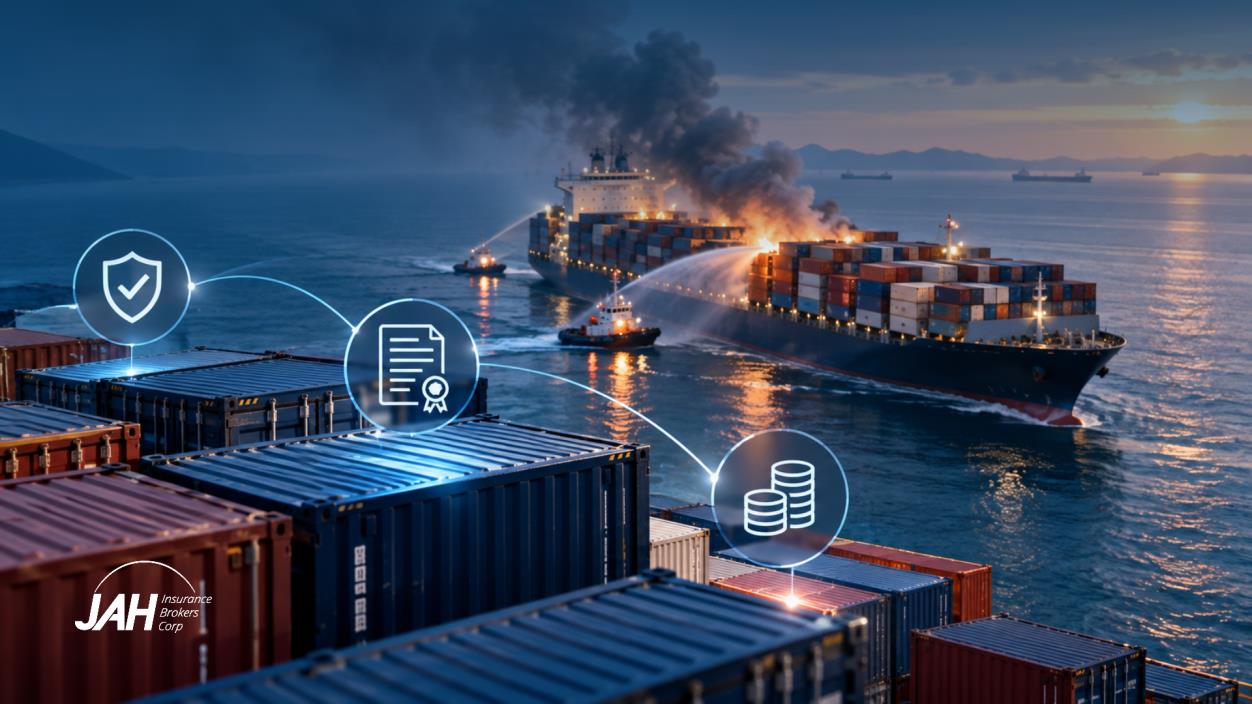
CMA CGM declared general average after the fire on board the CMA CGM Petra, which occurred on August 23 in the Strait of Malacca. Weeks later, the news put the focus back on cargo interests: cargo interests must post securities before they can take delivery of their goods. The case shows why a marine casualty can create financial consequences even when the container is not directly damaged.
What happened to the CMA CGM Petra?
The fire started when the CMA CGM Petra, a containership built in 2024 with capacity close to 8,000 TEU, was sailing through the Strait of Malacca, about 45 nautical miles northwest of Penang, Malaysia. The vessel had left Singapore and was bound for East Africa on the KILIMA service, according to MasContainer.
The crew initially contained the fire, but salvage specialists were required for firefighting and recovery operations. The vessel was later moved to Port Klang, where around 450 containers were to be discharged for inspection, according to Splash247.
Up to that point it might look like another marine casualty. But one element changes the economic dimension of the case entirely: CMA CGM declared general average. With that decision, the issue stopped being only an onboard emergency and also became a financial matter for the different interests involved in the maritime adventure.
What is general average?
General average, or General Average, rests on a particular principle of maritime law. When, in the face of a common peril, an extraordinary sacrifice is intentionally and reasonably made, or extraordinary expenses are incurred, to preserve the vessel, the cargo, and the other interests committed to the voyage, certain costs may be shared among the parties that benefited from the saving of the maritime adventure.
That means the fact that goods did not suffer direct damage does not necessarily mean their owner stays outside the process.
In the Petra case, the declaration followed the extraordinary firefighting and salvage operations. CMA CGM appointed Albatross Adjusters to administer the process, while W K Webster confirmed that cargo interests must provide the corresponding general average security before delivery of the goods, according to MasContainer.
General average and compensation for damage are not the same
This is one of the points that is most important to understand: general average is not the same as compensation for damage to the cargo. They are different processes that can coexist in the same casualty.
Intact cargo, but with obligations: the hidden risk of general average
Imagine a company that had a container on board the Petra. The fire did not reach its container and the goods are physically intact. At first glance, it might seem that company walked away completely unscathed.
However, if the cargo is part of the maritime adventure that benefited from the extraordinary measures taken to preserve the vessel and the goods, its owner may be drawn into the general average process and need to post a security before recovering the cargo, as explained by SAFETY4SEA.
That is precisely why these cases can come as a major surprise for importers and exporters. Financial risk does not necessarily end where physical damage ends.
From fire to salvage: where the cost appears
When a fire of this kind occurs, the response can involve far more than the vessel’s normal operations. It may be necessary to:
- engage specialized salvage services;
- use tugs;
- fight the fire for extended periods;
- divert the vessel to a port of refuge;
- discharge containers for inspection;
- carry out technical investigations into the origin of the casualty.
In the Petra case, SMIT professionals took part in the firefighting and salvage operations, and the vessel was moved to Port Klang to continue inspection and recovery work, according to W.E. Cox Claims Group Limited.
It is precisely the extraordinary nature of these costs that sits behind the general average declaration. That is why looking only at the value of the damaged cargo can give an incomplete picture of the financial exposure.
What happens to the cargo after the fire?
The next step is not simply to discharge the containers and continue the voyage. First it must be determined which cargo was affected, which can continue, which damage was caused directly by the fire, and which may have resulted from the operations used to control the emergency.
In Port Klang, discharge and inspection of approximately 450 containers was contemplated, according to World Ports Organization.
That means an emergency on an international route can create consequences long after the fire is controlled: inspections, surveys, additional documentation, securities, coordination with adjusters, and recovery processes. And, of course, time. For a company importing critical goods, that time can also become an operating cost.
General average and Cargo Insurance: what to review
This is where the Petra case leaves an important lesson for importers and exporters. When a company buys Cargo Insurance, it should not think only about the possibility that goods get wet, break, or catch fire. It should also ask what happens when the casualty creates a general average or salvage situation.
Cargo coverages may respond to certain obligations arising from these processes, but that depends on the specific policy conditions, the coverage purchased, and its exclusions. Reviewing the policy after the casualty is too late: the review should be done before shipment.
Three questions a company should ask before its next shipment
Does my policy cover general average?
It is not enough to know that a cargo policy exists. You need to review expressly how it responds to a general average declaration and which conditions apply.
What happens if my cargo is not damaged, but the vessel is?
The Petra case shows why this question matters. The absence of direct physical damage does not necessarily eliminate obligations related to the maritime adventure.
Who can handle the security and the recovery process?
When cargo is caught in a marine emergency, speed in managing documentation and securities can be decisive to keep the operational problem from dragging on.
A risk many companies discover too late
The CMA CGM Petra case again puts a maritime logistics reality on the table: cargo does not travel alone. It shares a vessel, a route, and a set of risks with hundreds or thousands of other containers. When a major emergency occurs, the consequences can extend far beyond the goods directly affected.
That is why insuring cargo should not be reduced to asking how much the policy costs. You also need to understand what happens in the least expected scenario: a fire can damage goods, stop an operation, divert a vessel, and generate extraordinary costs. And, as the Petra case shows, it can trigger a general average process that forces you to look at insurance from a much broader perspective.
Risk management starts before the vessel sails.
References
- CMA CGM. (2026, September). Customer advisory: CMA CGM PETRA – fire incident and general average declaration. CMA CGM.
- Container News. (2026, September 16). General Average declared after CMA CGM Petra fire.
- Raján, P. A. (2026, September 17). General average declared for fire-hit CMA CGM Petra. World Ports Organization.
- Safety4Sea. (2026, September 17). General average declared for fire-hit CMA CGM Petra.
- The Loadstar. (2026, September 16). General average declared on CMA CGM Petra as Maersk wins $13m fire case.
- The Maritime Executive. (2026, September 16). CMA CGM invokes general average after cargo hold fire.
- W.E. Cox Claims Group Limited. (2026, September 14). New casualty – CMA CGM PETRA – Fire – General Average likely to be declared.
- W K Webster & Co Ltd. (2026). CMA CGM PETRA: General Average security required.